
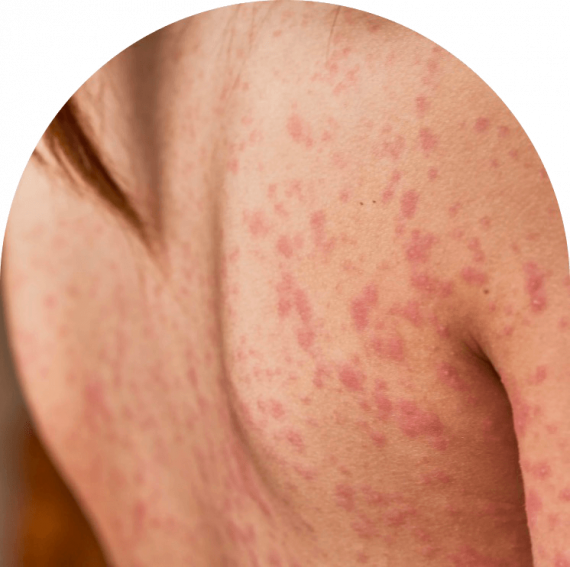
Psoriasis is a chronic autoimmune skin condition in which the immune system causes skin cells to grow and turn over far too quickly – in days rather than weeks.
This leads to a build-up of cells on the skin's surface, forming the raised, red, scaly patches characteristic of the condition.
Psoriasis most commonly affects the scalp, elbows, knees, and lower back, but can appear anywhere on the body.
Psoriasis is not contagious and is not caused by poor hygiene. It follows a relapsing-remitting pattern, with periods of flare and periods where the skin clears or improves. In some people it is mild and limited to small areas; in others it is extensive and significantly affects quality of life.
Around a third of people with psoriasis also develop psoriatic arthritis, a form of inflammatory joint disease.
How common is Psoriasis?
Psoriasis affects approximately 2–3% of Australians – around 500,000 to 700,000 people. It can develop at any age but most commonly appears in two peak windows: between 15 and 35 years, and again between 50 and 60 years.
It affects men and women equally. Psoriasis has a strong genetic component – having a parent or sibling with psoriasis significantly increases risk.
The most common form is plaque psoriasis, which accounts for around 80–90% of cases.
Symptoms include:
-
- Raised, red or pink patches of skin covered with thick, silvery-white scales
- Dry, cracked skin that may bleed or itch
- Itching, burning, or soreness in affected areas
- Thickened, pitted, or ridged nails – or nails that separate from the nail bed
- Swollen and stiff joints (which may indicate psoriatic arthritis)
- Scalp involvement, which can cause visible scaling, flaking, and itching
Other types of psoriasis include guttate (small, drop-shaped lesions, often triggered by streptococcal infection), inverse (smooth, red patches in skin folds), pustular (pus-filled blisters), and erythrodermic (a severe, widespread form requiring urgent medical attention).
Psoriasis results from an overactive immune response that accelerates the skin cell cycle.
The underlying cause involves:
-
- Genetics – psoriasis runs strongly in families; multiple genes have been associated with increased risk
- Immune system dysfunction – T-cells in the immune system mistakenly attack healthy skin cells, triggering inflammation and rapid cell turnover
- Environmental triggers – these do not cause psoriasis but can initiate or worsen flares in people who are genetically predisposed.
Common triggers include stress, skin injury (the Koebner phenomenon), streptococcal throat infections, certain medications (including lithium, beta-blockers, and antimalarials), smoking, and heavy alcohol consumption
Psoriasis is usually diagnosed clinically – a doctor will examine the skin, scalp, and nails and ask about symptoms, family history, and potential triggers.
In most cases no further testing is needed.
Occasionally:
-
- Skin biopsy – a small sample of skin is examined under a microscope to confirm the diagnosis or rule out other skin conditions
- Severity assessment – the Psoriasis Area and Severity Index (PASI) is used to measure the extent and severity of disease, which guides treatment decisions and PBS eligibility for biologic therapies
Referral to a dermatologist is recommended for moderate to severe psoriasis or when first-line treatments have not provided adequate control.
Treatment is guided by the extent and severity of psoriasis and the impact on quality of life. Management is stepwise.
Topical treatments
Used for mild to moderate psoriasis and as adjuncts in more severe disease:
-
- Topical corticosteroids – reduce inflammation and slow skin cell turnover; the most commonly used first-line treatment
- Vitamin D analogues – such as calcipotriol (Daivonex), which slow skin cell growth; often used in combination with topical steroids
- Topical retinoids – tazarotene, for localised psoriasis
- Coal tar – an older treatment with anti-inflammatory and anti-scaling properties; available in various formulations
Phototherapy
-
- Narrowband UVB phototherapy is an effective option for widespread psoriasis not responding adequately to topical treatment.
- Administered in a clinic several times per week.
Systemic treatments for moderate to severe disease
-
- Methotrexate – a well-established immunosuppressant used as a first-line systemic treatment; taken weekly as a tablet or injection
- Cyclosporin – an immunosuppressant used for short-to-medium term control of severe psoriasis
- Acitretin – an oral retinoid used for certain types of psoriasis, including pustular and erythrodermic
- Apremilast (Otezla) – an oral PDE4 inhibitor that reduces inflammatory signalling; a targeted therapy that does not require blood monitoring like traditional immunosuppressants
- Biologic therapies — target specific immune pathways driving psoriasis. Options include TNF inhibitors, IL-17 inhibitors, IL-23 inhibitors, and IL-12/23 inhibitors, used for moderate to severe plaque psoriasis.
The following specialty medications are available at Ace, a specialty pharmacy for Psoriasis.
Biosimilars of adalimumab are available. Speak with your Ace pharmacist about your options.
Note: Methotrexate and cyclosporin are used in psoriasis treatment but are general medications. Topical treatments (corticosteroids, vitamin D analogues) are not specialty medications.
With Ace, you’ll benefit from:
-
- Expert Support — Our dedicated team of health concierges is always available to answer your questions, provide guidance, and help you navigate your condition with confidence.
- Specialty Medication — We offer a wide range of specialty medications and support services, designed specifically for those living with chronic illnesses. Whether you’re looking for help managing a specific condition, or simply need access to the medications you need, we’ve got you covered.
- A Wide Range of Conditions — From diabetes to heart disease, and everything in between, we help manage a variety of special condition
Take control of your health and well-being, and start your journey to better health with Ace today.
Psoriasis-Specific Support
-
- Psoriasis Australia – peer support, information, and advocacy for Australians with psoriasis
- Psoriasis Australia – Find a Dermatologist
Broader Skin Health Resources
-
- Healthdirect – Psoriasis
- Australasian College of Dermatologists – Find a Dermatologist
- Musculoskeletal Health Australia – Psoriatic Arthritis – for people whose psoriasis has affected their joints
Clinical & Research Resources